
The Pharmaceutical Cold Chain: Keeping Medicines Safe
A practical guide to the pharmaceutical cold chain, the 2-8C range, temperature excursions, monitoring, and last-mile risk, written for hospital and clinic supply teams.
What is the pharmaceutical cold chain?
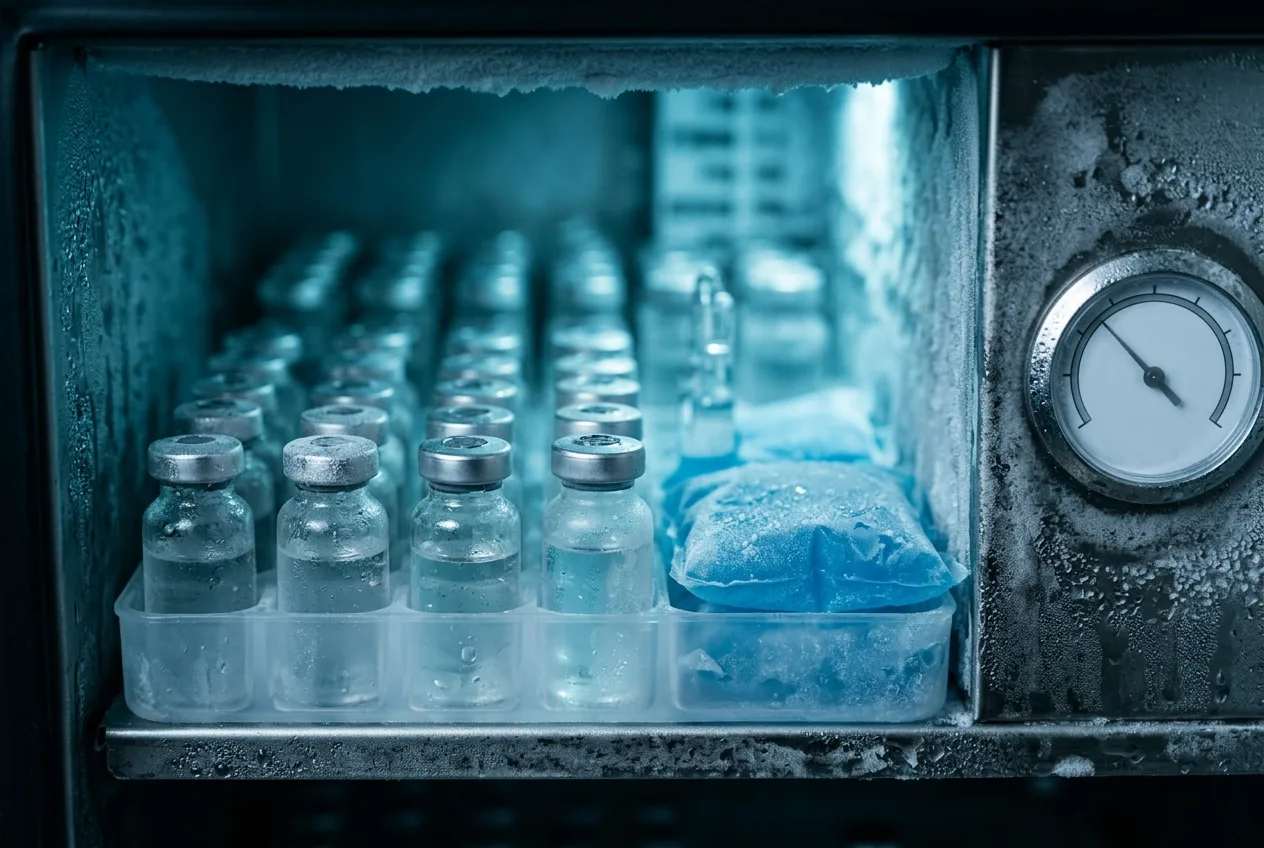
The pharmaceutical cold chain is the unbroken system of refrigerated storage, transport, and monitoring that keeps temperature-sensitive medicines within their approved range from the moment they leave the manufacturer until a patient receives them. For most refrigerated products that range is 2C to 8C. Break it at any point, and the product can lose potency without changing color, smell, or appearance, which is what makes cold chain failures so dangerous.
The Pan American Health Organization, the WHO regional office for the Americas, defines the cold chain as "a set of rules and procedures that ensure the proper storage and distribution of vaccines to health services from the national to the local level." The same logic now covers insulin, many biologics, certain antibiotics and ophthalmic products, and a growing share of modern medicines. Cold chain logistics is the discipline of running that system: the equipment, the packaging, the data, and the people who keep it intact.
For a hospital or clinic supply manager, the cold chain is not one event. It is a continuous chain of custody. Every transfer point between the importer's warehouse, the delivery vehicle, your loading dock, and your pharmacy fridge is a point where temperature can drift. The chain is only as strong as its warmest link.
Why does temperature control matter for medicines?
Temperature control matters because heat and freezing both destroy the active ingredients in temperature-sensitive drugs, and the damage is usually invisible and permanent. A vaccine vial that spent a weekend at room temperature can look perfectly normal and still deliver a fraction of its intended dose.
Biologics, vaccines, and insulin are proteins or complex biological molecules. When they get too warm, the proteins can unfold and clump together, a process called denaturation and aggregation. A peer-reviewed review of refrigerated medication stability published in the National Library of Medicine notes that temperature excursions cause protein degradation, loss of potency, and potential safety risks, and that the damage can occur rapidly. Freezing is just as harmful: it can break the molecular structure of a vaccine or cause insulin to form particles, and a frozen vaccine is generally considered unusable.
The clinical consequence is the real cost. A patient who receives a degraded vaccine may believe they are protected when they are not. A diabetic patient using heat-damaged insulin may not get reliable glucose control. For a procurement team, a single mishandled shipment can mean a wasted budget, a recall, a stockout, and a regulatory inquiry, all at once.
The temperature categories: refrigerated, frozen, and controlled room temperature
Medicines fall into a few standard temperature bands, and knowing which band a product belongs to is the foundation of safe handling. Most cold chain products live in the refrigerated band, but not all of them.
- Refrigerated (2C to 8C). This is the core cold chain range. According to the US Centers for Disease Control and Prevention Pink Book, vaccine refrigerators should maintain temperatures between 2C and 8C (36F and 46F). Most vaccines, insulin in long-term storage, and many biologics sit here.
- Frozen (-50C to -15C). Some products require a freezer. The CDC specifies that vaccine freezers should maintain temperatures between -50C and -15C. A subset of vaccines, including certain varicella and zoster formulations, are stored frozen rather than refrigerated.
- Ultra-cold (-80C to -60C). A newer category driven by some mRNA products, requiring specialized ultra-low freezers and careful dry-ice handling.
- Controlled room temperature (typically 20C to 25C). Many oral medicines are not cold chain products at all, but they still have an approved range and should not be left in a hot vehicle or a sun-exposed store room.
Two practical rules follow. First, never assume a product is "just a fridge item" without checking its label and the manufacturer's guidance. Second, never store a frozen-only product in a 2C to 8C refrigerator, or a refrigerated product in a freezer. The wrong band is its own kind of excursion.
What goes wrong: temperature excursions and potency loss
A temperature excursion is any period during which a product sits outside its approved range, and it is the single most common cold chain failure. The CDC defines an excursion as any reading outside the manufacturer's recommended range and treats it as an event that requires immediate action: stop using the affected stock, label it, and contact the manufacturer or program for a stability assessment before deciding whether it can be salvaged.
Excursions are rarely dramatic. They are usually quiet and cumulative:
- A delivery left on a loading dock in summer heat while paperwork is sorted out.
- A refrigerator door propped open during a busy clinic, or a unit packed so tightly that air cannot circulate.
- A power cut overnight with no alarm and no one to notice.
- A domestic-style fridge used for storage, which cycles temperature far more than a purpose-built pharmaceutical unit.
The potency consequences are well documented. Research published in the journal Diabetes Technology and Therapeutics found that insulin in real-world home and patient-carried conditions is frequently stored outside the recommended 2C to 8C range, raising the risk of reduced effectiveness. For vaccines, a peer-reviewed analysis found some influenza formulations were effectively inactive after about five weeks at room temperature. The lesson for supply managers is that "it still looks fine" is never a safety standard. Only documented temperature history can tell you whether a product is still good.
How is the cold chain monitored?
The cold chain is monitored with continuous electronic temperature loggers that record data at fixed intervals, so that any excursion is captured with a timestamp and a duration. A thermometer you glance at twice a day is not monitoring; it tells you the temperature at two moments and nothing about the other twenty-three hours.
The CDC recommends a calibrated digital data logger in every storage unit, recording at intervals of no more than every 30 minutes, with an accuracy of plus or minus 0.5C. Two details separate real monitoring from box-ticking:
- Buffered probes. The CDC notes that temperatures measured by a buffered probe (one immersed in a fluid such as glycol) match vaccine temperature more closely than those measured by standard thermometers, which tend instead to reflect air temperature. Air spikes the moment a door opens; a buffered probe shows what the product actually experienced.
- Calibration. Each logger should carry a current Certificate of Calibration Testing. An uncalibrated logger that reads 2C low can hide a genuine excursion or trigger false alarms.
Good practice extends monitoring across the whole chain, not just the fridge. In-transit data loggers travel inside the shipment, so the receiving team can review the full temperature history on arrival and reject a load that drifted en route. Alarms, including out-of-hours notifications for power failures, turn a passive record into an active safeguard.
Packaging and the last mile: where the chain breaks
Most cold chain failures happen in transit and at the point of handover, not in the warehouse, which makes packaging and last-mile discipline the highest-leverage place to invest. A well-run national depot can still lose a shipment in the final hour of a hot delivery run.
Qualified packaging is the first defense. Validated insulated shippers, the correct number and conditioning of gel packs or phase-change materials, and pack-out configurations tested against real ambient profiles all keep product in range for a defined number of hours. The key word is validated: packaging should be proven to hold temperature for the expected journey, not assumed to.
The last mile is where theory meets a hot afternoon. Risk concentrates at a few predictable points: the loading dock where a shipment waits in ambient heat, the unrefrigerated vehicle cabin, the clinic that has no one ready to receive and shelve a delivery, and the rushed handover where no one checks the in-transit logger. Each is manageable with a simple rule: minimize the time product spends outside controlled storage, and verify temperature at every handover before signing for it.
This is acute in Qatar. With summer ambient temperatures regularly exceeding 45C, the gap between a controlled vehicle and an exposed dock is enormous, and packaging that performs well in a mild climate may fail here. A distributor operating in the Gulf has to design for worst-case heat, not average conditions. This is one reason healthcare buyers in Qatar look closely at a partner's cold chain capability. As a Doha-based importer and distributor serving hospitals, clinics, and pharmacies, Sun Drug Store operates temperature-controlled storage and a nationwide distribution network built for local conditions, working with the Qatar Ministry of Public Health on registration and compliance.
What good cold chain practice looks like
Good cold chain practice is a documented, end-to-end system in which every link is qualified, monitored, and auditable. It is not a single piece of equipment; it is a way of operating that you can prove on paper.
The core elements are consistent across credible operators:
- Qualified equipment. Purpose-built pharmaceutical refrigerators and freezers, not domestic units, with backup power for storage facilities.
- Continuous monitoring everywhere. Calibrated digital data loggers in storage and in transit, with alarms and out-of-hours alerting.
- Validated packaging. Pack-outs proven to hold the required band for the planned journey time and the local climate.
- Written procedures. Clear steps for receiving, storing, excursion response, and product disposition, with trained staff who follow them.
- Traceability. Temperature records, batch numbers, and chain-of-custody documentation retained for audit.
This framework sits inside the broader rules of Good Distribution Practice, the quality system that governs how medicines are stored and moved. For more on that, see our guide to Good Distribution Practice (GDP). The cold chain itself is one specialized part of the wider pharmaceutical distribution system that connects manufacturers to patients. And when you are evaluating who should handle your temperature-sensitive products, our guide on how to choose a pharmaceutical distributor in Qatar covers what to ask about cold chain capability before you sign.
Working with a cold-chain-capable distributor
If you manage supply for a hospital, clinic, or pharmacy and you handle vaccines, insulin, or biologics, the cold chain is worth raising with your distributor directly: how do you monitor in transit, how do you handle excursions, and how do you protect product in Qatar's heat. Sun Drug Store is built for these requirements and serves healthcare organizations across the country. To discuss temperature-controlled supply for your facility, contact our team.
Sources and further reading
- Cold Chain, PAHO/WHO (Pan American Health Organization)
- Chapter 5: Vaccine Storage and Handling, Pink Book, US CDC
- Vaccine Storage and Handling Toolkit: Temperature Excursions, US CDC (PDF)
- Stability of Refrigerated Medications at Room Temperature, National Library of Medicine (PMC)
- Storage Conditions of Insulin in Domestic Refrigerators and When Carried by Patients, Diabetes Technology and Therapeutics
Frequently Asked Questions
What temperature is the pharmaceutical cold chain kept at?
The standard refrigerated cold chain range is 2C to 8C (36F to 46F), which covers most vaccines, insulin in long-term storage, and many biologics. Some products require a freezer band of roughly -50C to -15C, and a small number of newer products need ultra-cold storage near -80C to -60C. The correct range is set by the manufacturer and stated on the product label.
What is a temperature excursion?
A temperature excursion is any period during which a medicine is exposed to temperatures outside its approved storage range, whether too warm or too cold. The CDC treats an excursion as an event requiring immediate action: stop using the affected stock, isolate and label it, and contact the manufacturer for a stability assessment before deciding whether it can still be used. The product should never be assumed safe just because it looks normal.
Can you tell if a vaccine or insulin has been damaged by heat just by looking?
In most cases, no. Heat damage to vaccines, insulin, and other biologics is usually invisible: the product can look, smell, and appear completely normal while having lost much of its potency. This is precisely why continuous temperature monitoring and documented temperature history are essential, because they are the only reliable way to know whether a product stayed in range.
Why is cold chain harder in Qatar's climate?
Qatar's summer ambient temperatures regularly exceed 45C, which increases the rate of heat damage and shortens the safe out-of-fridge window for sensitive products. Packaging and procedures that work in a mild climate may fail in Gulf heat, so cold chain in Qatar has to be designed for worst-case conditions, with particular attention to loading docks, vehicle cabins, and fast handovers.
What is a digital data logger and why is it required?
A digital data logger is an electronic device that records storage temperature automatically at fixed intervals, capturing the full temperature history rather than a single reading. The CDC recommends a calibrated logger in every storage unit, recording at least every 30 minutes with an accuracy of plus or minus 0.5C, often using a buffered probe that reflects product temperature rather than air temperature. It is required because it is the only reliable way to prove a product stayed in range and to detect excursions a manual check would miss.
What is the difference between the cold chain and Good Distribution Practice?
The cold chain is the specific system of temperature-controlled storage, transport, and monitoring for temperature-sensitive products. Good Distribution Practice (GDP) is the broader quality framework that governs how all medicines are stored, handled, and distributed, including documentation, traceability, and staff training. The cold chain is one specialized component that operates inside a GDP-compliant distribution system.