
Cosmeceuticals and Medicated Cosmetics Explained
A plain-language guide to cosmeceuticals, dermocosmetics, and medicated cosmetics: where they sit between cosmetics and drugs, the active ingredients with real evidence, and how to read a skincare label.
What is a cosmeceutical?
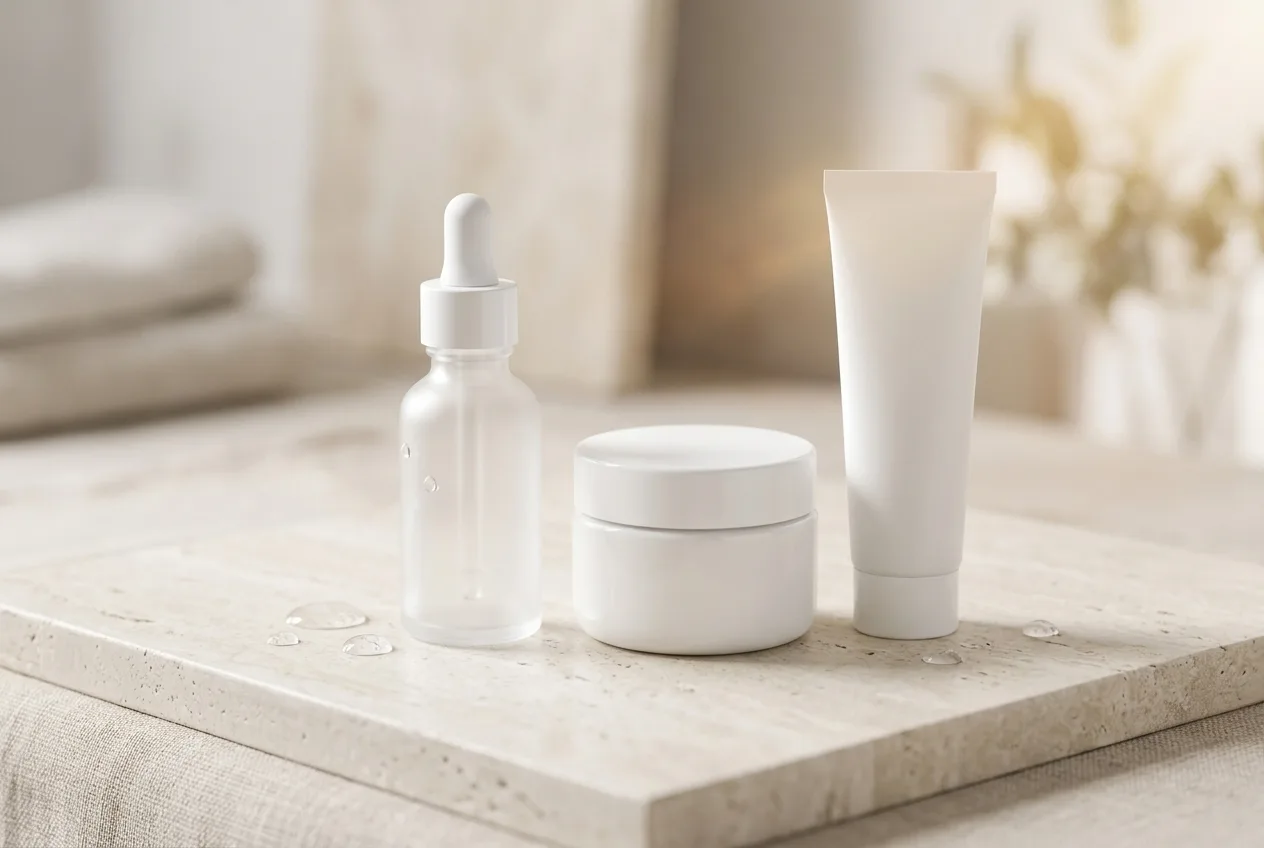
A cosmeceutical is a cosmetic product that contains biologically active ingredients claimed to deliver a skin benefit beyond simple decoration or cleansing. Think of a vitamin C serum for dark spots, a retinol cream for fine lines, or a niacinamide moisturizer for an uneven complexion. The word is a blend of "cosmetic" and "pharmaceutical," and it captures products that sit in the space between a plain moisturizer and a prescription drug.
Here is the part most buyers and shoppers miss: "cosmeceutical" is a marketing term, not a legal category. According to the US Food and Drug Administration, the Federal Food, Drug, and Cosmetic Act does not recognize the term "cosmeceutical," and the word has no meaning under the law. A product is legally a cosmetic, a drug, or both. The prefix on the bottle does not change which set of rules applies to it.
"Dermocosmetics" and "medicated cosmetics" describe the same broad idea from slightly different angles. Dermocosmetics is the term favored in Europe and across much of the world for clinically tested skincare with dermatologically active ingredients. Medicated cosmetics usually points to products whose ingredients edge closer to an actual drug claim. None of these labels is standardized, so the smart approach is to ignore the buzzword and read what the product actually contains and claims to do.
How cosmeceuticals sit between cosmetics and drugs
The line between a cosmetic and a drug is drawn by intended use, not by how advanced the formula sounds. The FDA defines a cosmetic as an article intended to be applied to the body for cleansing, beautifying, promoting attractiveness, or altering the appearance. It defines a drug as an article intended to diagnose, cure, mitigate, treat, or prevent disease, or to affect the structure or any function of the body.
That single distinction has large consequences. Cosmetics in most markets do not require pre-market approval, while drugs face a far heavier burden of testing, manufacturing controls, and registration. A cosmeceutical lives in the tension between those two worlds. It wants the credibility of a drug-like result while staying inside the lighter regulatory lane of a cosmetic.
Some products genuinely qualify as both. The FDA's standing example is antidandruff shampoo: it is a cosmetic because it cleanses hair, and a drug because it treats dandruff, so it must meet the requirements for both. The same logic applies to many everyday items. A moisturizer with broad-spectrum SPF is a cosmetic that is also an over-the-counter drug because of the sunscreen actives. If you want a deeper look at where that regulatory line falls, our guide to over-the-counter versus prescription medicines walks through how intended use and claims decide a product's category.
The takeaway for a buyer is simple. A claim like "softens the look of fine lines" keeps a product in cosmetic territory. A claim like "treats acne" or "reduces inflammation" pushes it toward a drug, with all the obligations that follow.
The regulatory grey area, and why it matters
Cosmeceuticals occupy a genuine regulatory grey area, and pretending otherwise is how buyers get burned. Because the category is not defined in law, two products on the same shelf can use identical language while one is backed by clinical data and the other is backed by nothing more than confident copywriting.
In the United States, cosmetic claims do not need FDA approval before going to market, but the FDA is explicit that labeling and claims must be truthful and not misleading. If a brand crosses into disease or structure-and-function claims, the product is being marketed as an unapproved drug and can face enforcement. The Modernization of Cosmetics Regulation Act of 2022 (MoCRA) added facility registration, product listing, and adverse-event recordkeeping requirements, which raised the floor on cosmetic oversight, but it did not create a "cosmeceutical" category either.
Other regions handle the same products under their own frameworks. In Qatar, cosmetics and the products often marketed as cosmeceuticals are overseen by the Ministry of Public Health (MOPH), which sets registration and labeling expectations for what enters the market. For an importer or distributor, this means a product's classification can shift across borders, and what is sold as a casual cosmetic in one country may need closer documentation in another.
For retail pharmacy buyers, three habits cut through the noise:
- Match the claim to the category. Strong therapeutic language signals a drug-level obligation, regardless of the "cosmeceutical" label.
- Ask for the evidence behind a result claim, ideally human studies on the finished product, not just a single ingredient in a lab dish.
- Confirm the product is properly registered for the market you sell in, and that labeling meets local rules.
Cosmeceutical ingredients that actually have evidence
A short list of active ingredients carries most of the real, peer-reviewed evidence in skincare. A 2024 review of popular cosmeceuticals in the journal Skin Health and Disease concluded that retinoids, vitamin C, alpha and beta hydroxy acids, niacinamide, and broad-spectrum sunscreens are among the best supported, while many trendy actives rest mainly on laboratory data with few human trials. Knowing which is which is the difference between an informed purchase and an expensive guess.
- Retinoids (retinol, retinaldehyde, and prescription tretinoin). Vitamin A derivatives that speed skin cell turnover. The American Academy of Dermatology notes retinol can give younger-looking skin and is used for uneven tone, dark spots, and texture, typically applied at night. Prescription-strength retinoids are drugs; lower-strength retinol sits on the cosmetic side.
- Niacinamide (vitamin B3). One of the best-characterized cosmetic actives. An NCBI review describes its anti-inflammatory and barrier-strengthening effects and its role in evening tone, which makes it a frequent choice for sensitive skin.
- Vitamin C (ascorbic acid). An antioxidant the AAD says can reduce signs of skin aging and dark spots, commonly applied in the morning before sunscreen.
- Salicylic acid (a BHA) and alpha hydroxy acids. Exfoliating acids used for clogged pores, acne, and texture. At higher strengths and with treatment claims, these can be regulated as drugs.
- Hyaluronic acid. A humectant that holds water in the skin to improve hydration and the look of fine lines. It is a comfort-and-appearance ingredient, not a disease treatment.
- Sunscreen actives (such as zinc oxide and titanium dioxide). These are drug ingredients in many markets, including the US, where sunscreen is an over-the-counter drug. They sit inside countless "cosmeceutical" moisturizers. Because UV exposure is intense in the Gulf, our guide to choosing sunscreen and sun protection in Qatar covers what to look for locally.
One honest caveat runs through all of this: results depend on the formulation, the concentration, and the individual. The same ingredient at a token concentration in a poorly designed base will not match a well-formulated product, even if both list it on the label.
How to read a cosmeceutical label
Read the label from the claim down to the ingredient list, and let evidence override marketing. The front of the pack tells you how the product is positioned. The back tells you what is actually inside. When the two disagree, trust the back.
Start with the claim. Appearance language ("reduces the look of," "helps brighten") keeps a product a cosmetic. Therapeutic language ("treats," "heals," "prevents") is a drug claim and should come with the testing a drug requires. Next, read the ingredient list, which in most markets is ordered by concentration, highest first. A celebrated active buried near the bottom, after the fragrance, is likely present in a token amount.
A few practical checks:
- Look for a named active at a sensible position in the list, not just mentioned on the front.
- Prefer products that cite evidence on the finished formula, and be skeptical of claims resting on a single in-vitro study.
- Check for required market registration and clear, accurate labeling for where you sell.
- For result-driven actives like retinoids and acids, factor in tolerance, patch testing, and pregnancy precautions, and point shoppers to a dermatologist or pharmacist when in doubt.
This is also where a trustworthy supply chain earns its keep. Sun Drug Store, a Qatar-based importer and distributor founded in 2018 and based in Al Wakrah, handles medicated cosmetics alongside pharmaceuticals, supplements, and medical devices, and works with the MOPH on registration and compliance, so retail buyers receive properly documented stock rather than grey-market guesswork. Storage and handling matter for actives too: vitamin C and retinoids degrade with heat and light, which is why the same care principles behind the pharmaceutical cold chain apply to sensitive skincare.
Talk to a partner who knows the category
If you are a pharmacy or healthcare buyer in Qatar weighing a cosmeceutical or medicated cosmetics range, it helps to work with a distributor that understands both the science and the registration rules. Sun Drug Store imports from more than a dozen countries and supplies hospitals, clinics, and retail pharmacies nationwide. Reach the team through our contact page to discuss sourcing, documentation, and compliant labeling for your shelves.
Sources and further reading
- US FDA, "Cosmeceutical" Label on Cosmetics: https://www.fda.gov/cosmetics/cosmetics-labeling-claims/cosmeceutical
- US FDA, Is It a Cosmetic, a Drug, or Both? (Or Is It Soap?): https://www.fda.gov/cosmetics/cosmetics-laws-regulations/it-cosmetic-drug-or-both-or-it-soap
- US FDA, Cosmetics Labeling Claims: https://www.fda.gov/cosmetics/cosmetics-labeling/cosmetics-labeling-claims
- American Academy of Dermatology, A dermatologist's guide to skincare: https://www.aad.org/news/dermatologist-guide-skincare
- Crous et al., Overview of popular cosmeceuticals in dermatology, Skin Health and Disease (2024), via NCBI: https://pmc.ncbi.nlm.nih.gov/articles/PMC10988741/
- Mechanistic insights into the multiple functions of niacinamide, NCBI: https://www.ncbi.nlm.nih.gov/pmc/articles/PMC11047333/
- Qatar Ministry of Public Health: https://www.moph.gov.qa/
Frequently Asked Questions
Is "cosmeceutical" an official, regulated category?
No. According to the US FDA, the Federal Food, Drug, and Cosmetic Act does not recognize the term "cosmeceutical," and it has no meaning under the law. A product is legally treated as a cosmetic, a drug, or both, based on its intended use and the claims it makes. The label word is marketing, not a regulatory status.
What is the difference between cosmeceuticals, dermocosmetics, and medicated cosmetics?
They describe broadly the same idea: cosmetic products that contain active ingredients meant to produce a skin benefit. "Dermocosmetics" is common in Europe and emphasizes clinical testing, while "medicated cosmetics" suggests ingredients closer to a drug effect. None of the three terms is standardized in law, so judge the product by its ingredients and claims rather than the name.
How do I know if a skincare product is actually a drug?
Look at the claim. If a product says it treats, cures, prevents, or affects the structure or function of the body, such as treating acne or providing sun protection, it is being marketed as a drug and must meet drug requirements. If it only claims to clean, beautify, or change appearance, it is a cosmetic. Many products, like SPF moisturizers and antidandruff shampoos, are legally both.
Which cosmeceutical ingredients have the most scientific evidence?
Retinoids, vitamin C, niacinamide, alpha and beta hydroxy acids, hyaluronic acid, and broad-spectrum sunscreen actives have the strongest peer-reviewed support. A 2024 dermatology review found these are among the best studied, while many other trendy ingredients rely mainly on laboratory data with few human trials. Results still depend on the concentration, the formulation, and individual skin.
Why does the position of an ingredient on the label matter?
In most markets, ingredient lists are ordered by concentration from highest to lowest. A heavily promoted active that appears near the bottom of the list, after preservatives or fragrance, is usually present in only a small amount. Checking where an ingredient sits helps you tell a meaningful formula from one using a famous name for marketing.
Are cosmeceuticals regulated differently in Qatar?
Cosmetics and the products marketed as cosmeceuticals fall under the oversight of the Qatar Ministry of Public Health (MOPH), which sets registration and labeling expectations for the local market. A product sold casually as a cosmetic elsewhere may require closer documentation to enter Qatar. Buyers should confirm that any range is properly registered and correctly labeled for sale in the country.